
When performance data is split across systems, the problem may be visibility, not effort. An integrated business management system brings related operational information into a shared view, helping teams make decisions from consistent records and track processes using the same information. It is especially useful when staff spend time reconciling records or managers struggle to connect day-to-day activity with business performance.
Separate tools can work well for individual tasks, but integration helps when those tasks depend on information held elsewhere. The goal is not technology for its own sake. It is clearer oversight, fewer conflicting records, and more consistent handling of routine work.
This article explains how integrated systems bring information together, support operational decisions, and make performance trends easier to follow. It also covers how shared processes and governance features can support consistent work, and what to consider when deciding whether an integrated approach suits your operations.
Key Takeaways
- Bring related operational records into a shared view so teams can work from current, consistent information.
- Use structured data across departments to support decisions, identify trends and connect daily activity with performance.
- Align governance, responsibilities and information controls to support consistent processes as operations change.
- Assess how inventory tracking, sales execution, invoicing and customer and supplier workflows could be coordinated in SAP Business Management System.
Centralised information and dashboards
Features can include connected applications, dashboards, policies, training information, and shared business records. These applications use a shared database to link related functions, so updates can inform the same operational view.
Centralised business information
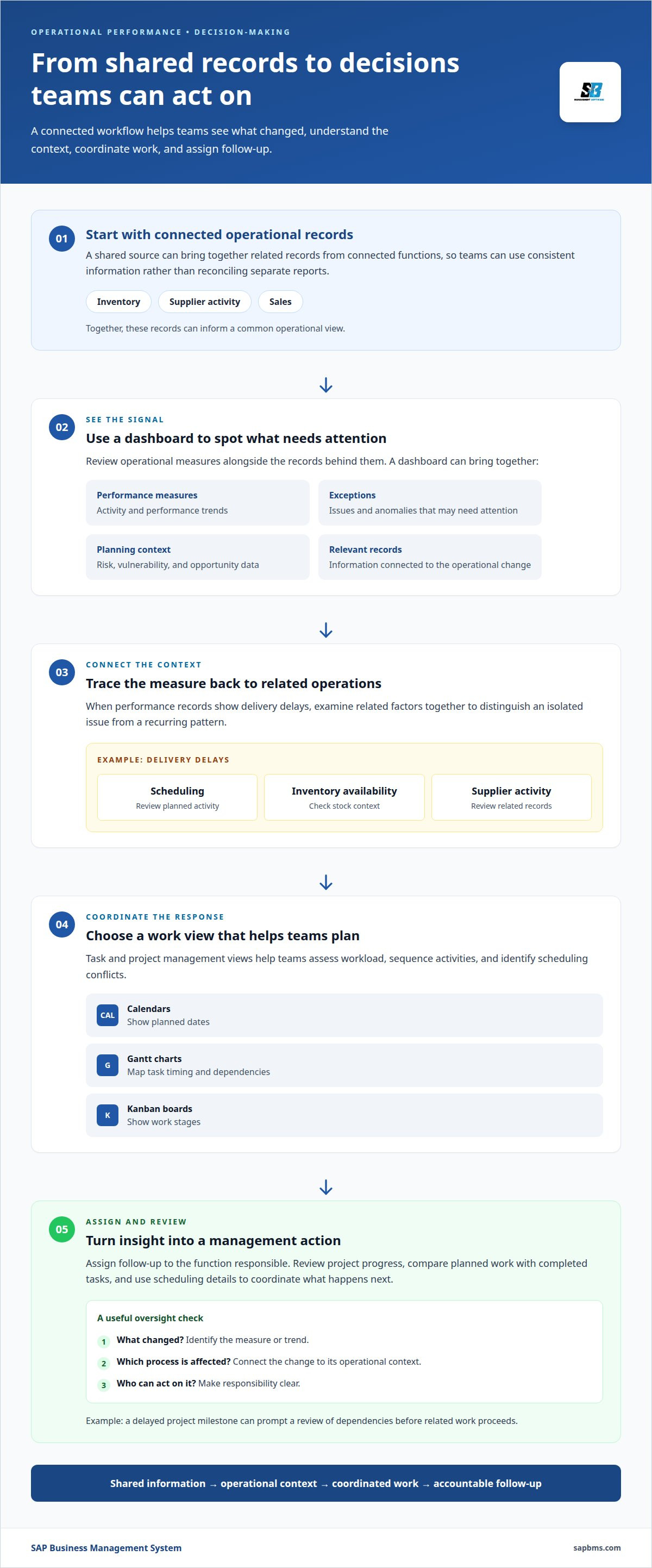
Centralised business information brings records from connected functions into one shared source. Staff can find current material without reconciling separate versions. For example, inventory, supplier, and sales records can inform a common operational view. A central location for policies, training information, and documents also helps teams access consistent information.
Dashboard features
A dashboard presents selected operational information to help teams monitor activity and identify what needs attention. It can bring risk, vulnerability, and opportunity data together for planning. Teams can also review performance measures, trends, issues, and anomalies alongside relevant records, helping managers relate operational changes to the information behind their decisions.
Management standards provide defined subject areas for organizing records and oversight. According to the International Organization for Standardization (ISO), ISO 9001 is an internationally recognised quality management standard. According to the International Organization for Standardization (ISO), ISO 14001 is an environmental management standard. According to the International Organization for Standardization (ISO), ISO 45001 is an occupational health and safety management standard.
According to the International Organization for Standardization (ISO), ISO 50001 is an energy management standard. According to the International Organization for Standardization (ISO), ISO 55001 is an asset management standard. According to the International Organization for Standardization (ISO), ISO 22301 is a business continuity management standard. These named areas help frame which information a central view may need to organize.
According to the International Organization for Standardization (ISO), OHSAS 18001 was an older standard replaced by ISO 45001. A shared system can organize related documents, training information, and operational records around the standards relevant to an organization. Centralized access supports review of the information teams use to manage these areas.
Operational performance and decision-making
Operational decisions depend on information that departments can interpret consistently. A shared source of structured records helps managers compare activity across teams instead of relying on separate reports. For example, sales demand and inventory status can inform a stock decision together. The value lies in connecting data to a decision, not simply collecting more records.
An integrated approach can support complex problem-solving by connecting operational measures with relevant context. If performance records show delivery delays, managers can examine scheduling, inventory availability, and supplier activity as related factors. This helps distinguish an isolated issue from a recurring pattern. Teams can then assign follow-up to the function responsible for addressing it.
Task and project management features offer another way to support decisions. Calendars show planned dates, Gantt charts map task timing and dependencies, and Kanban boards show work stages. These views help teams assess workload, sequence activities, and spot scheduling conflicts. Managers can use them to decide whether priorities or assignments need adjusting.
Performance information is most useful when it supports a specific management action. Teams can review project progress, compare planned work with completed tasks, and use scheduling details to coordinate what happens next. For example, a delayed project milestone may prompt a review of dependencies before related work proceeds.
Useful oversight depends on selecting measures that relate to operational objectives. A dashboard or report should clarify what changed, which process is affected, and who can act on it. Without that connection, figures may be visible but have limited decision value. Organizations assessing suitable business management system tools can consider how operational records and work coordination support their decision-making needs.
Benefits of integrating management systems
An integrated business management system links functions and records across departments. ERP software typically focuses on core business transactions and planning. Standalone tools handle specific tasks, while connected systems can share information across processes such as inventory, invoicing, and budgeting.
Choose a system by mapping the processes it must support, the information they use, and the roles that need access. Assess whether functions such as costing, budgeting, analytics, onboarding, and risk review can work from connected records. Also consider how permissions protect sensitive information and whether the system can exchange data with your existing business software.
In the U.S., software cost depends on the scope and requirements of the business and is provided after a quote request. Factors include users, integrations, data migration, and support requirements.
Implementation generally involves defining requirements, assigning process owners, preparing records, configuring access, and testing connected workflows. Teams can then train users, address data or process issues, and review performance measures after launch. For example, test whether an inventory update correctly informs the sales or purchasing workflow.
Common implementation challenges include inconsistent records, unclear ownership, access errors, and disruption to established work. Reduce these risks by assigning data owners, setting permissions according to job responsibilities, and validating key workflows before wider use. Training matters too: employees need to know which records to maintain and how changes affect connected processes.
Integration can support growth by clarifying responsibilities, coordinating onboarding, and combining cost and performance information. Governance features can restrict sensitive records to authorised users, while centralized information security management helps organizations consider confidentiality, integrity, and availability. A shared management review can also replace several separate reviews, reducing duplicate oversight while keeping connected business functions in view.
An integrated system can bring costing, budgeting, and analytics together with data from other departmental applications, and exchange data with other business software to trigger related activity. Governance applications can assign roles and responsibilities to restrict sensitive information to authorised users. As a business grows, integrated systems can also help clarify responsibilities, manage onboarding, and bring risks and opportunities into view.
An integrated system can notify individuals, groups, or an entire organisation about document changes, training requirements, customers, compliance requirements, risks, and opportunities. It can also support one management review instead of several separate reviews.
Consistent processes and performance tracking
Consistent processes define how work is completed, recorded, reviewed, and improved across teams. Performance tracking shows whether those processes produce the intended results. For example, a shared procedure for recording a customer issue helps employees capture comparable information. Managers can review the records for recurring causes, unresolved cases, and performance changes instead of relying on inconsistent descriptions.
A connected management system can collect employee reports about risks, issues, and nonconformances, then help organisations track trends, performance, and anomalies. If employees repeatedly report damaged stock, managers can examine where the problem occurs and whether it relates to handling or storage. Tracking the issue through to resolution makes follow-up part of the process.
Consistency also depends on current procedures and clear responsibilities. When a document changes, relevant employees and groups can receive updates about the change or related training requirements. For example, if a revised inspection procedure affects warehouse staff, the organisation can connect the document update with the employees who use it. This helps teams follow the same method and understand when their records need to change.
Review turns tracking into improvement. Teams can examine risk reports, nonconformance records, and performance trends, then identify processes that need adjustment. They can document the change, communicate updated requirements, and monitor later results to see whether the issue persists. This recurring review builds learning into daily work rather than treating improvement as a separate activity. Anomalies can also prompt investigation, helping teams distinguish an isolated event from a pattern that needs attention.
For operational teams, the practical test is whether processes, reports, and follow-up actions connect clearly. Review performance tracking options for coordinating inventory, sales, invoices, and customer and supplier workflows.
An integrated business management system can collect employee data on risks, issues, and nonconformances, then track trends, performance, and anomalies. It can also support a learning culture by making process review and improvement part of employees’ daily routines.
SAP Business Management System: SAP Business Management System
SAP Business Management System helps businesses coordinate inventory tracking, sales execution, point-of-sale receipts, invoicing, quotations, and customer and supplier workflows. These tools support routine commercial activity, from recording stock and preparing customer documents to managing supplier information.
It may suit operations seeking one platform for these tasks rather than handling each through disconnected processes. Consider it when your priority is coordinating sales and inventory records alongside customer and supplier administration. The relevant fit depends on which of these operational activities your business needs to manage through the system.
For information about SAP Business Management System, contact the business directly.
Set a clear direction for your next step
Before changing systems, identify the operational decision you most need to improve. Define what information supports it, who is responsible for maintaining that information, and how teams will use it. This gives an integrated business management system a practical purpose beyond consolidating software and gives stakeholders a shared basis for assessing whether it suits their working requirements.
Start with a clear business priority, then consider how connected records and workflows could support it. A focused evaluation can show which processes belong together and where consistent information would make daily administration easier. The aim is not to add complexity, but to create a workable foundation for decisions and ongoing process management.
For a closer look at the available business management system, contact SAP Business Management System. A clear operational priority is a useful starting point for the next discussion.
Frequently Asked Questions
Why should you move towards an integrated system?
Consider an integrated system when disconnected records make routine handoffs difficult. For example, a cancelled customer order may affect stock allocation, purchasing decisions, and customer follow-up. If each team records the change separately, coordination takes extra effort. Connecting the relevant workflows helps staff act on the same transaction status and makes follow-up responsibilities clearer.
What is an integrated business management system?
An integrated business management system connects related business functions through shared information and coordinated workflows. Rather than treating each task as an isolated record, it lets relevant activities inform one another. For example, a sales transaction can be associated with inventory and customer records, giving authorised staff a more connected view of the transaction.
What are the benefits and drawbacks of an integrated business management system?
Benefits can include less duplicate entry, clearer coordination between functions, and records that support consistent oversight. The trade-off is that teams must maintain accurate information and agree on shared working practices. A mistaken record can affect connected activities, and changes to established routines may require staff training. Integration is most useful when connected processes justify the coordination and governance involved.

